Knott Brothers in Concert
Take the Knott Brothers home with you!

All songs in one large zip file for your very personal device.
Music Down Home
March 31, 1983
Remember Me
Satisfied Mind
Oklahoma Hills
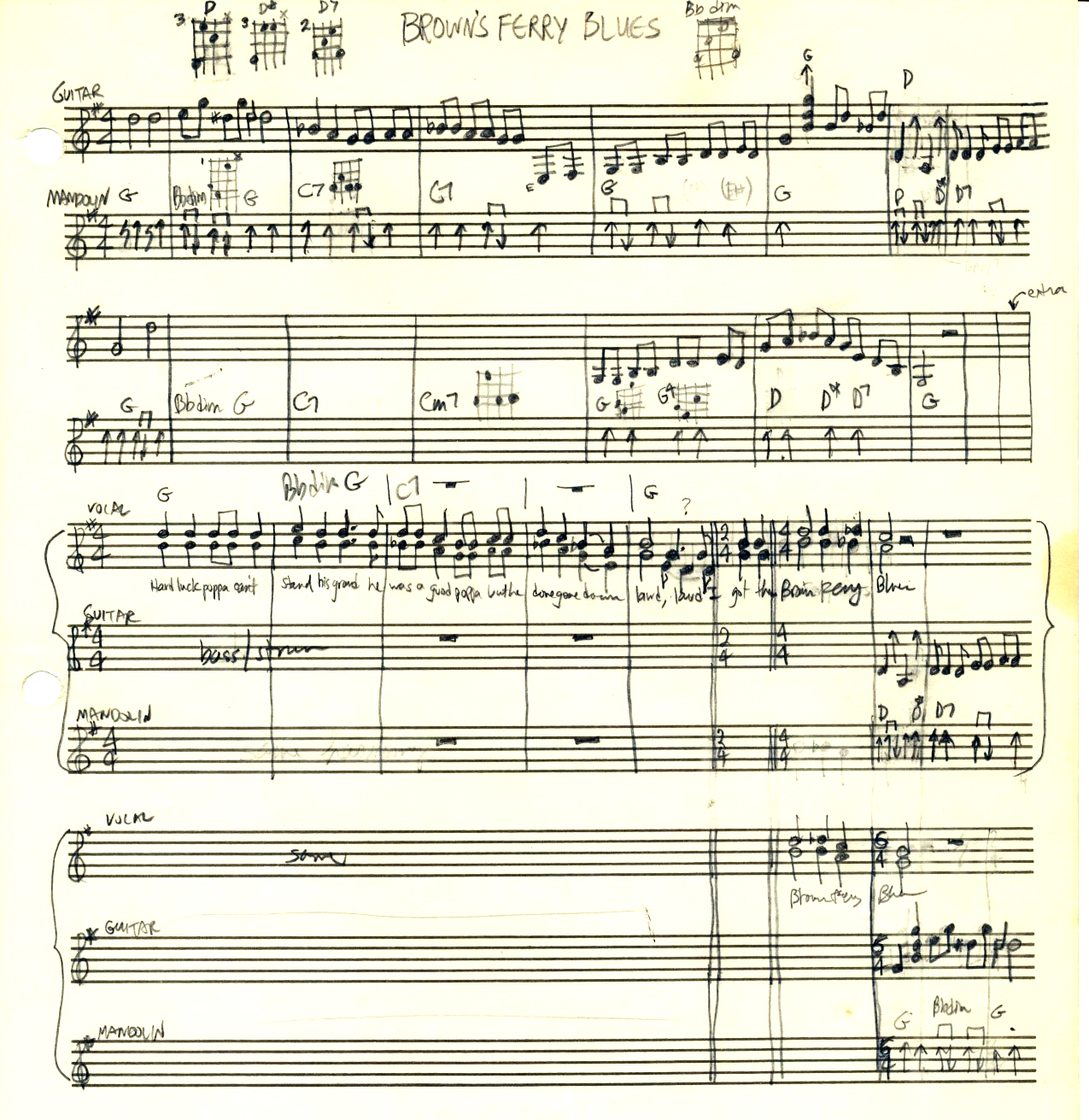
Browns Ferry Blues
Mother, the Queen of My Heart
Radio Boogie
Knott Family History
Gonna Lay Down My Old Guitar
Honky Tonk Man
Legend In My Time
Anchored In Love
Nashville Blues
Ida Sweet as Apple Cider
Mary of the Wild Moor
Anna from Indiana
Put Me on the Trail on the Carolina
Indiana Contra Dancers' Lament
Fugitve's Lament
Thinking Tonight of My Blue Eyes
Music Down Home
December, 1983
The Radio Ranger Welcomes the Knott Brothers
Knott Family History
You Tied A Love Knot In My Heart
Alabama
Bringing Mary Home
Six Days On the Road
Keep On the Sunny Side
Broken Hearted Lover
Yearning
I'll Be All Smiles Tonight
Till We Meet Again
Battleground
June, 1983
Dear Ivan
Battleground
June, 1984
Blues Stay Away From Me
If I Could Only Win Your Love
Fool's Paradise
At the End of the Rainbow Trail
Sea of Heartbreak
Kiva
Feb 1983
He Will Set Your Fields On Fire
Sunny Side of Life
All the Good Times Are Past and Gone
Daily Grind
1984
I'll Be True To the One I Love
Lost Highway
My Blue Ridge Mountain Home
Blue Railroad Train
The Streamlined Cannonball
Phantom 309
The Knott Brothers, 1983-1985

|
The Knott Brothers
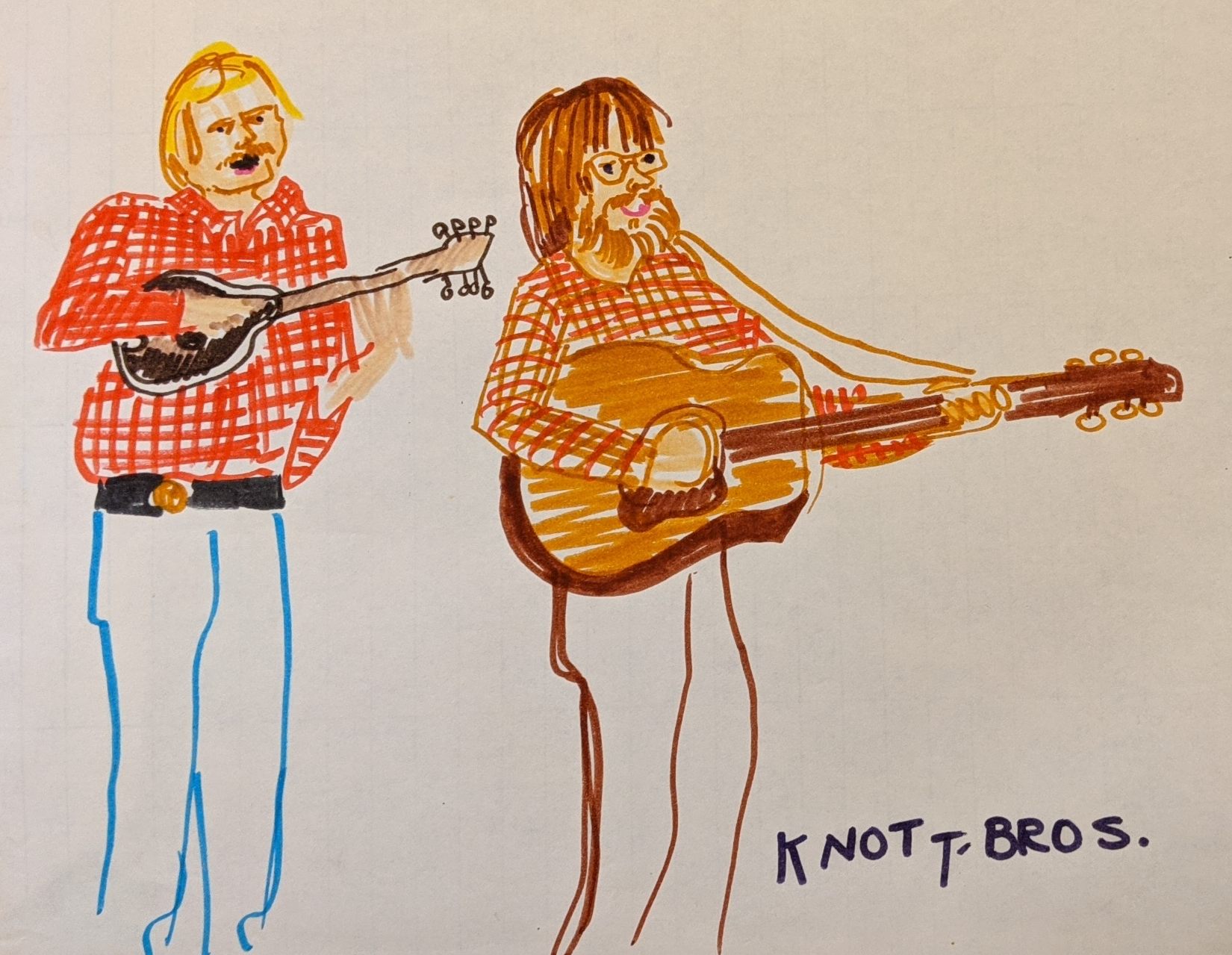
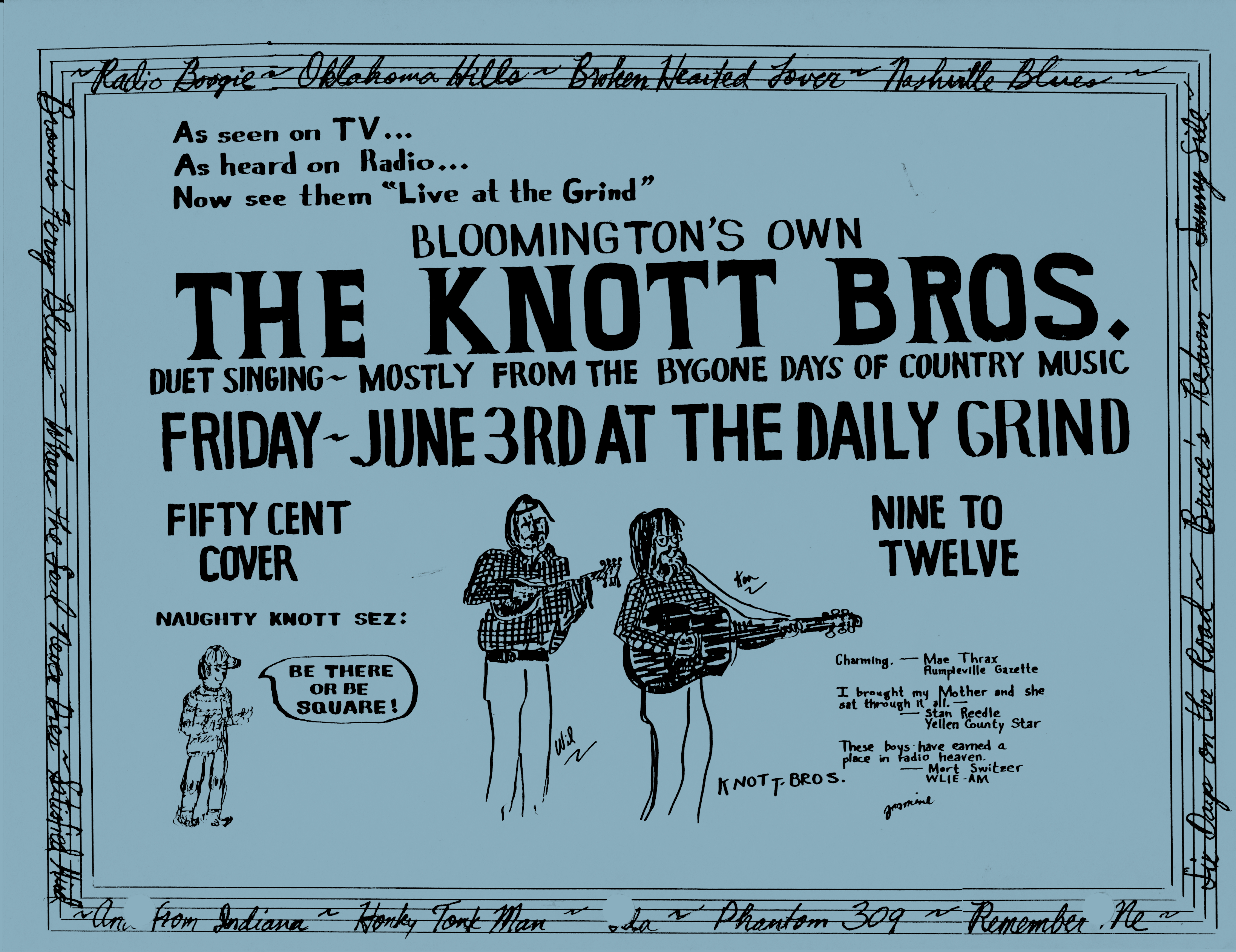
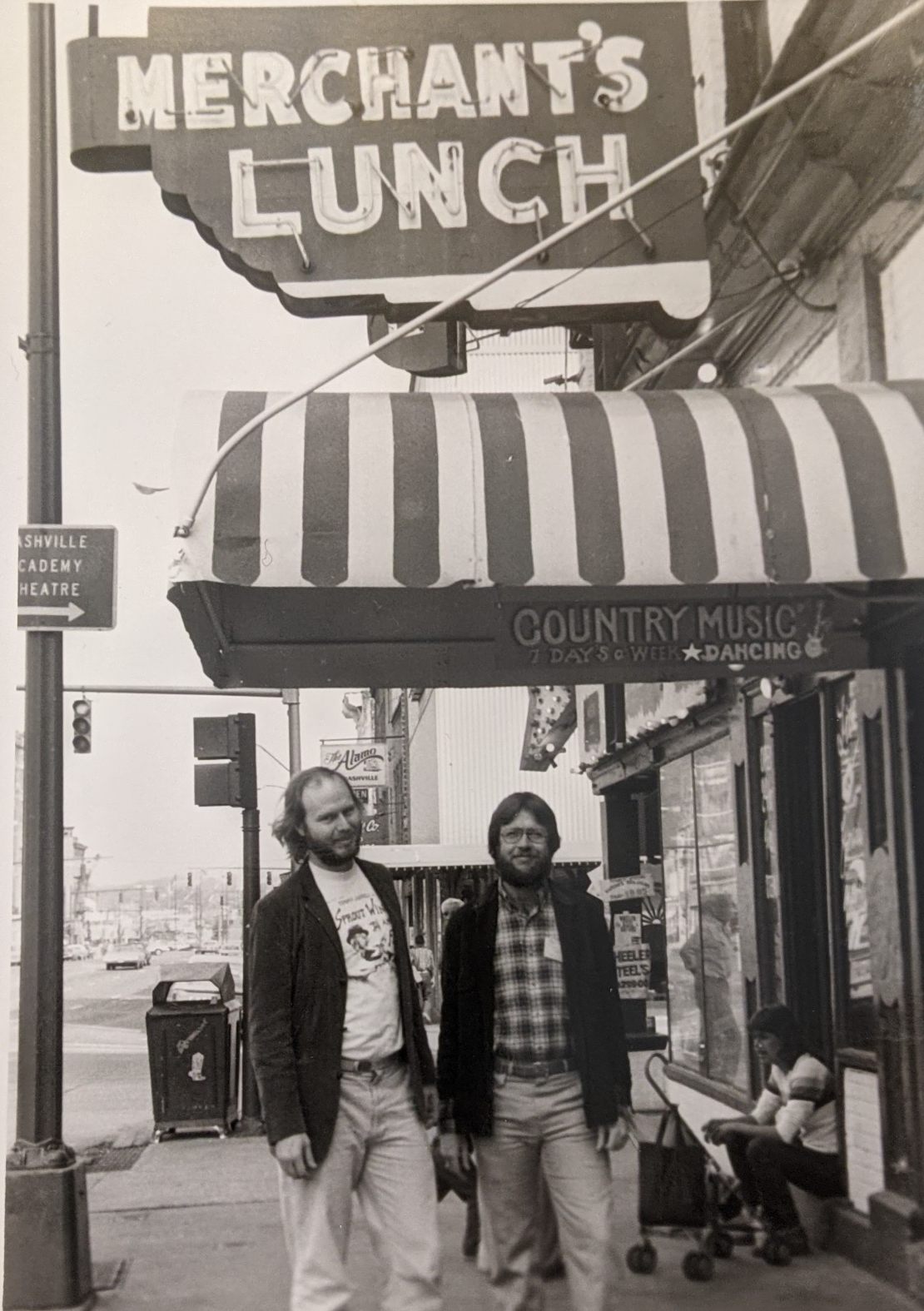
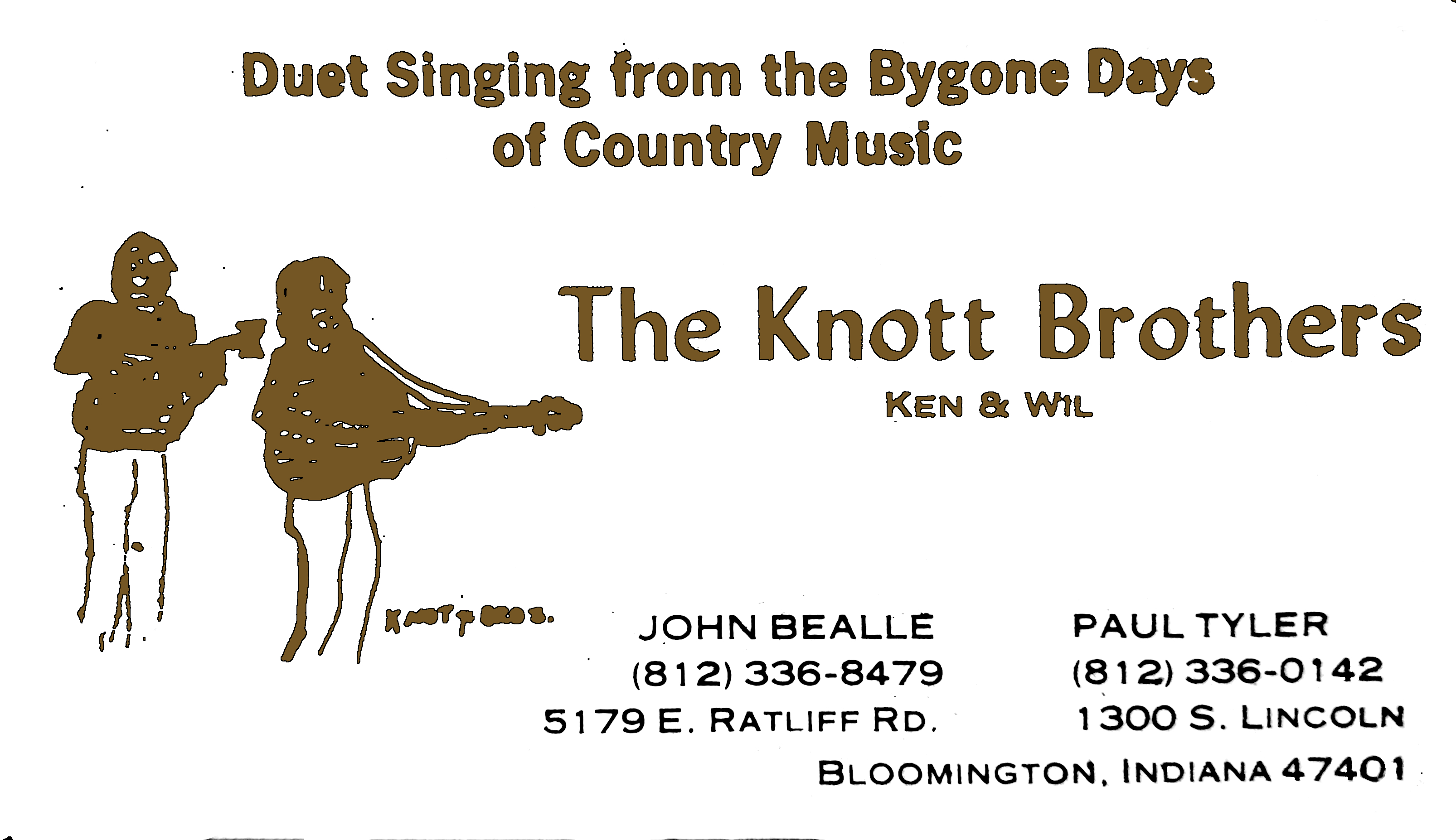
The Knott Brothers was a project of Paul Tyler and John Bealle, who met as folklore students at Indiana University. Their particular approach featured a reverence for historical country music with a veneer of country comedy—both common in country music performance. It was an approach that appealed easily to audiences outside of country music and was a staple of the Bloomington, Indiana, old-time music scene of the 1970s. Fans loved both the harmony and the humor, and sometimes contributed to the stock of narrative artifacts that comprised the fictional Knott family.
Brother Duets in Country Music
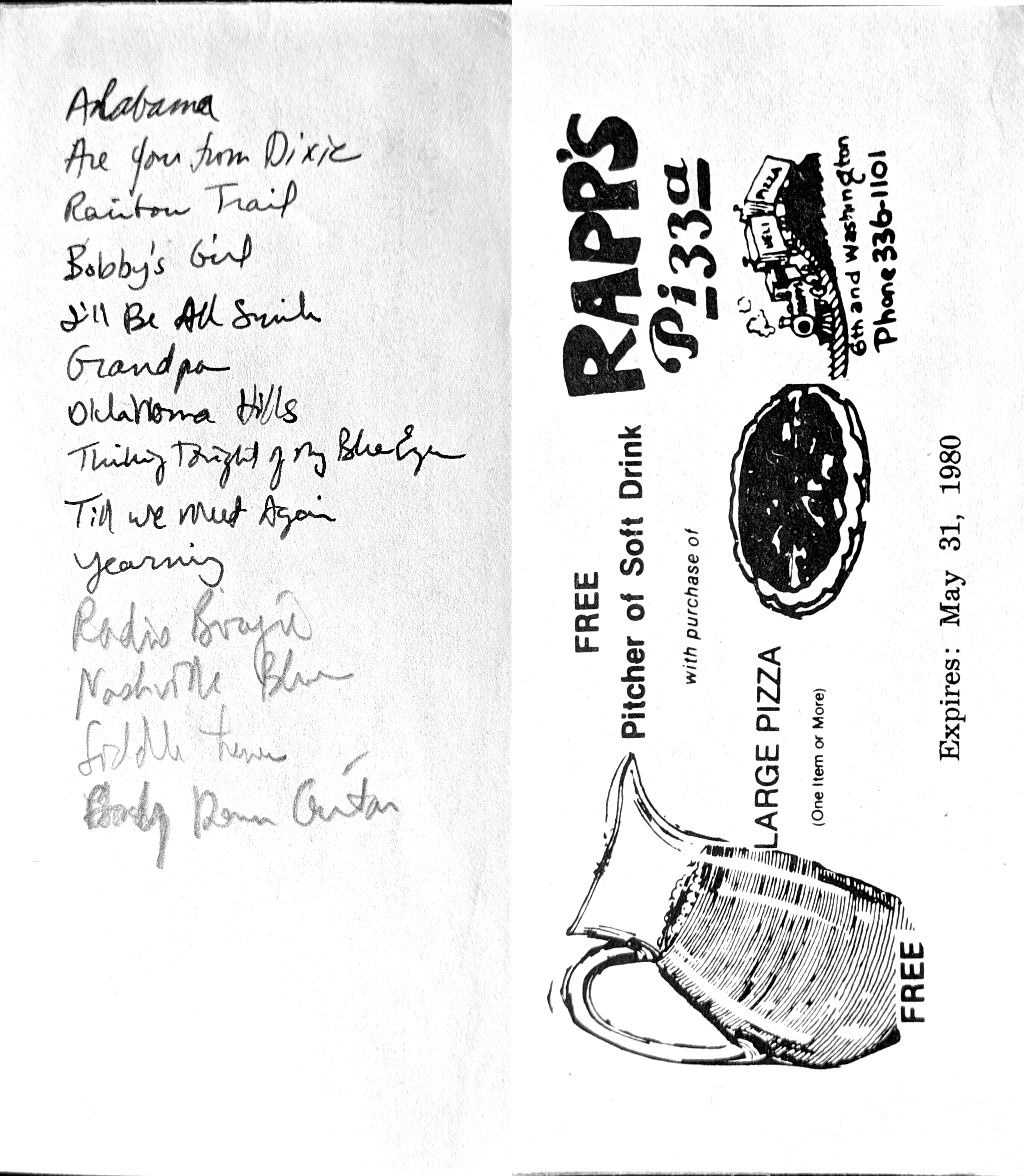
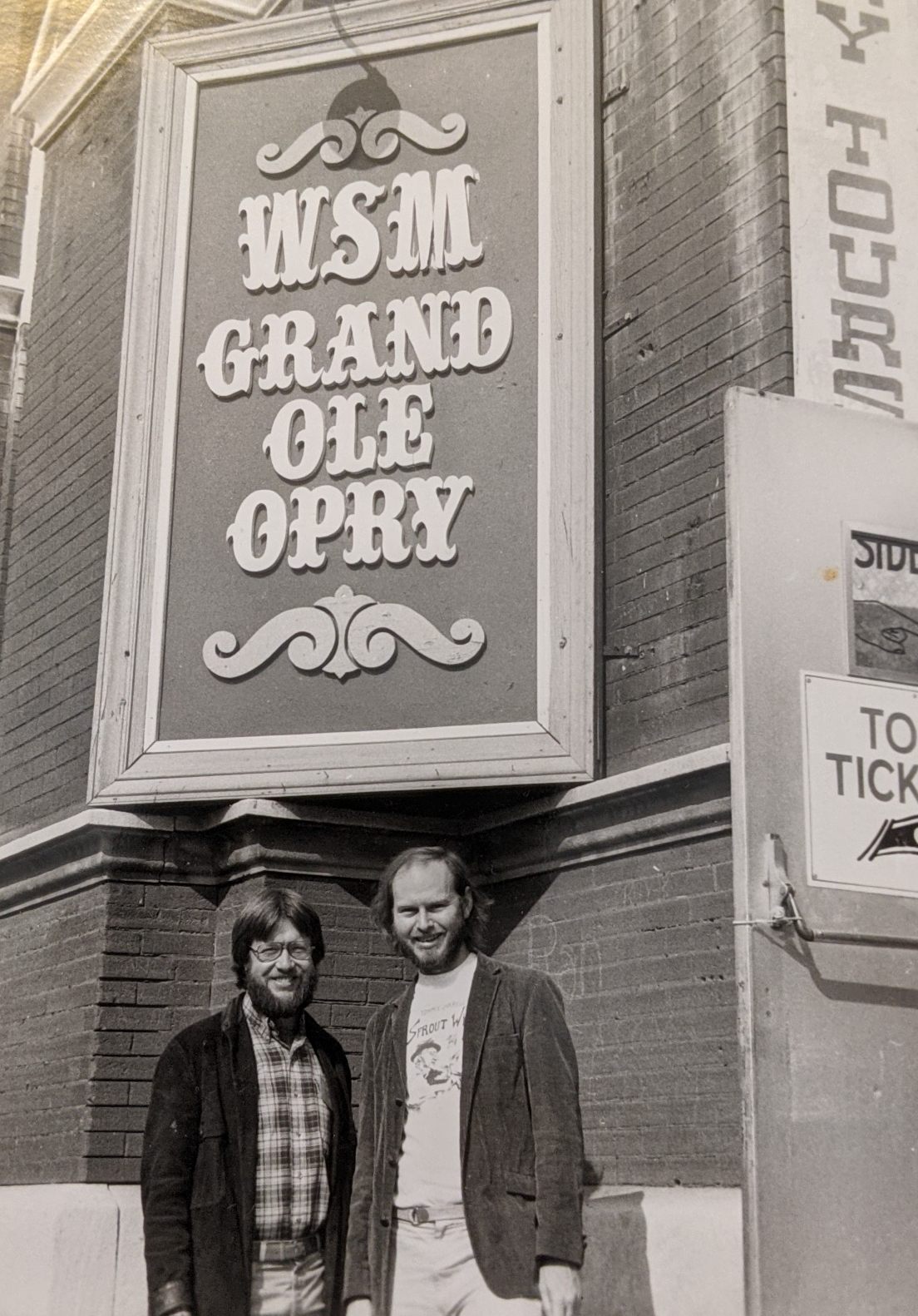
Brother duets were a common ensemble configuration in U.S. country music, beginning with the advent of commercial recordings and radio. The Delmore Brothers from northern Alabama were important as pioneers because of their access to large audiences through the WSM radio Grand Ole Opry. Other prominent duos were the Louvin Brothers, the Blue Sky Boys, and the Bailes Brothers. With the bluegrass era came the Monroe Brothers, Jim and Jesse, the Stanley Brothers, and the Lilly Brothers. Beginning in the 1950s, the Everly Brothers brought the brother duet sound to pop music and were an influence on the Beatles.
The songs sung by the duos reflect the prominent male experiences of the time—heartaches, homeplaces, hoboes, and the importance of mothers. The most influential recordings were made during the Great Depression by Appalachian artists, when men were sometimes separated from their families through work or from the lack of work. The site Old Time Party (from the Encyclopedia of Appalachia) explores the importance of Appalachia to the emergence of brother duets. The site Rate Your Music - Genre - Close Harmony has many pages of links listed chronologically. Bluegrass Lyrics - Brother Duets provides a sampling of brother duet song lyrics. The Country Music Project recounts the history of country music duet harmony by brothers and other configurations.
The Recordings
These recordings document three live performances in 1983, probably the most important performances of the Knott Brothers' career. The recordings have survived through the efforts of Paul Tyler and Gary Stanton.
Music Down Home. The radio program "Music Down Home" was a weekly folk music program of WFIU (Bloomington, Indiana) extending historically to the 1950s through previous hosts Phil Nussbaum and Joe Hickerson. When Stanton took over the program, he contrived an identity, in a fashion similar to the Knott Brothers performances, that enveloped audiences within a comedic fictional world.
He conceived the program, called Music Down Home, around an informal atmosphere, with imaginary friends close at hand. “We were a family—the listeners and I,” he later wrote, “and many of the ideas for programs and music for programs came from the people who listened.” Partly to overcome shyness, he invented a broadcast personality—the “Radio Ranger.” Throughout the program’s run, ensembles from the [Bloomington old-time music and] dance group made regular guest appearances, performing live and discussing their music. He routinely announced events of importance to the old—time music scene. Musical selections drew from a wide range of folk and ethnic recordings, but regional and local music and vintage recordings constituted the bulk of the playlist. At some point he devised a contest whereby listeners could phone with answers to a weekly trivia question, often on the subject of vintage old-time recordings. The prize was a “Radio Ranger” button with a likeness of this fictional character. (From John Bealle, Old-Time Music and Dance)
This recording is a Knott Brothers treasure because it was made in studio conditions in stereo. It features the lead-off song "Radio Boogie" with lyrics written by John as a tribute to the program itself.
Indiana Fiddlers' Gathering. This annual summer festival, known known colloquially as "Battleground," was founded in 1973 as an event honoring a local fiddler who at the time was in failing health. From an audience of 300 that first year, the festival grew to 10,000 by 1976 as the event took on the classic eclectic qualities of outdoor folk festivals (Bealle, Old-Time Music and Dance). It was a unifying event for regional old-time music revival communities, in the early years a chief gathering site for Chicago, Bloomington, and St. Louis. The festival was eventually able to attract important names—such as Jethro Burns, Liz Carroll, and Lotus Dickey—so in 1983 when the Knotts performed, it was for them a prestigious opportunity.
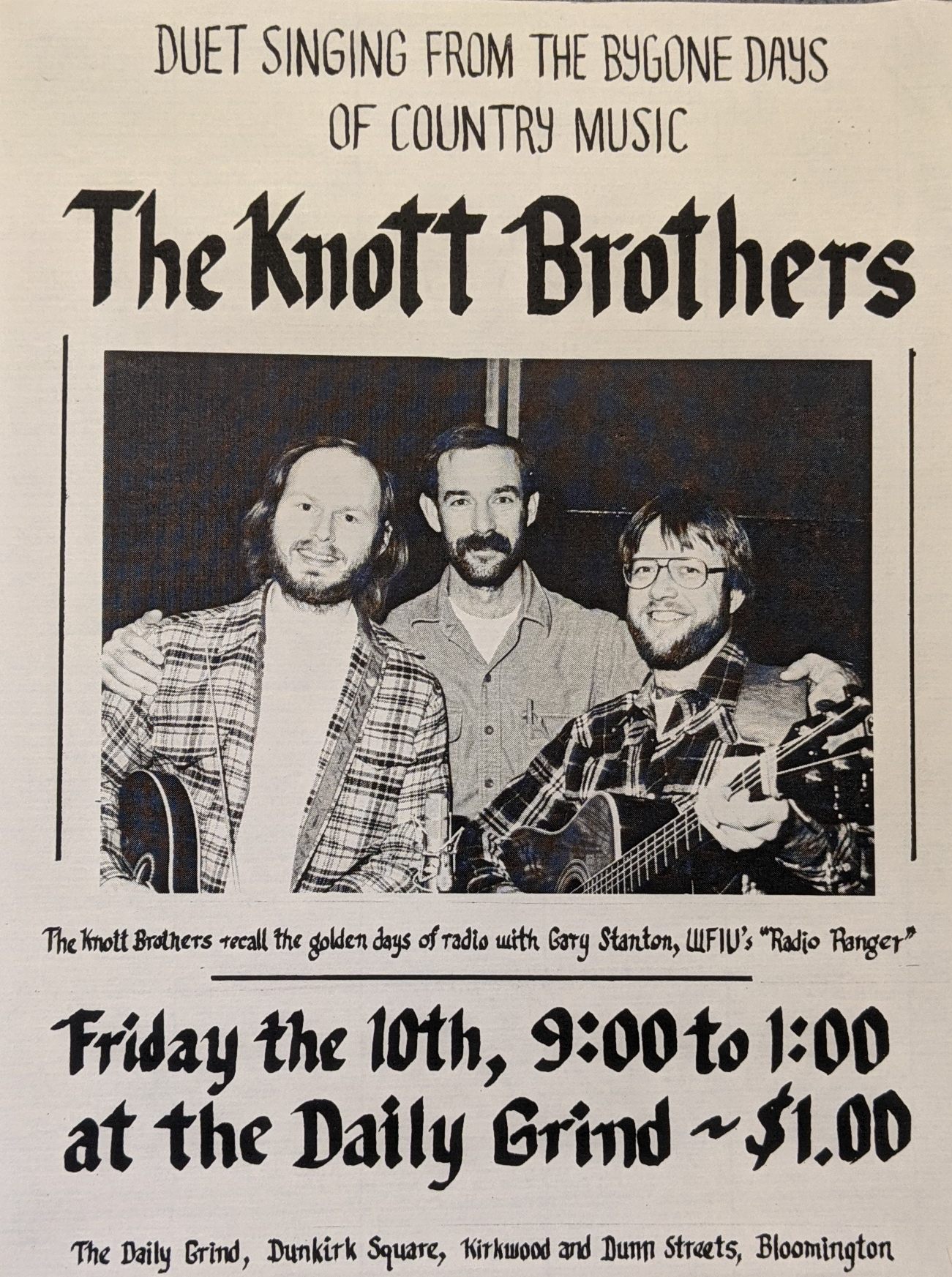
The Daily Grind. The Daily Grind was a coffeehouse that featured live music on the weekends. It was located in the Dunkirk Square shopping compound on the southwest corner of Dunn and Kirkwood.
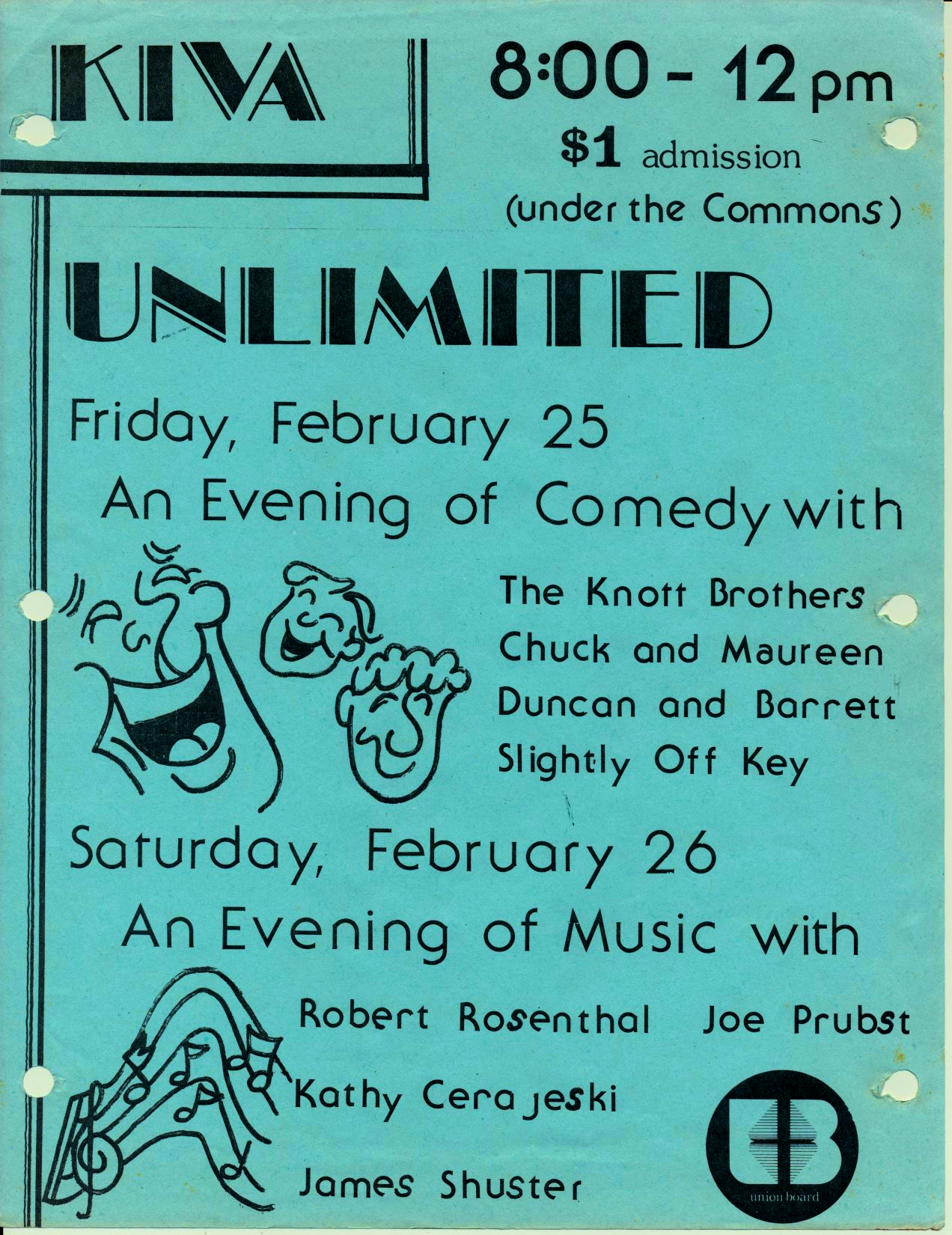
The Kiva. The Kiva was a student-oriented coffeehouse in the basement of the Indiana University Student Union. The Knott Brothers earned $15 for this performance.
|
John Remembers
"I remember mostly nervousness and unsteady singing. When I heard the recordings, it was a delightful surprise how good they were. Some of the harmonies were very ambitious, and we sometimes nailed them perfectly. Also impressive was the extraordinary breadth of material, most of that from Paul. There were plenty of mistakes—my favorite was fighting off laughter after singing that ridiculous line "Can there be no cure / For all my amour?" in "Yearning." I had always loved the brother duets: I once saw the Blue Sky Boys perform and had memorized Delmore Brothers songs hoping someday to find someone to sing them with. I didn't have a lot of experience with mandolin, but knew the fingering from fiddle playing. Never got completely comfortable with the pick. When Paul began introducing jazz arrangements, I had to scramble to find chord charts. I didn't like what I saw commercially, so I developed my own chord system. Definitely my favorite song was 'Remember Me'—that song was made for our voices, we nailed it every time with passion and authority. All of the filler phrases on mandolin and most of the harmony lines, those were my creations entirely—pretty cool to hear all of that."
|

|
|
The Knott Brothers in Real Life
Paul Tyler grew up in northern Indiana in a community with vibrant square dancing and country music traditions. Since his Bloomington days he has been an archivist and teacher at the renowned Old-Town School of Folk Music in Chicago. He has made numerous fieldwork recordings during his folklore career, housed on his website Dr. Dosido and contributed to the Indiana University Archives of Traditional Music. His chief performing project has been the Volo Bogtrotters old-time string band.
John Bealle grew up in Alabama and embraced traditional music as a teenager. Now in Cincinnati, he has spent his career as a folklorist and book indexer, and has contributed to service and advocacy organizations. His music and dance projects include the Queen City String Band, Cincinnati Sacred Harp, the Cincinnati Contra Dance, and Northside Square Dance, and a brief fling with ragtime guitar.
Thanks from Ken and Wil
A special thanks to our friends who made the Knott Brothers possible. To Eddie Grogan, for his fine song, "Indiana Contra Dancers' Lament." To Gary Stanton the "Radio Ranger" for his enthusiastic support. To Eileen Rice for the sketches that we used in all publicity. To our chief fan, Pat Mahaffee Gingrich, who held us in her heart as we grew into something more than we ever imagined. And to all the brothers-in-music who paved the way for us.